Go
The ancient game of Go has existed for thousands of years. You should try it.
One of the many great things about Go is you can play on any size board you like. Some people prefer the full 19 by 19 grid board but I find that full size Go can take a lot longer than I have time for with friends. Smaller boards have been catching on and keeping Go fresh. There are some really amazing resources out there to learn more about Go for instance Sensei's Library Here is how we play Go at the Red Eft Games table.
Components:
Go Board
Go Stones
Setup:
Decide who will play first, that player uses the Black Go Stones, second player uses the White Go Stones.
Red Eft Games Go Variant:
Each player starts with a fixed amount of stones. Each player has all of their Stones in hand. The amount of Stones depends on the size of the board and desired game length.
6x6 point boards use 18 Stones per color.
7x7 point boards (shown in the examples) use 24 Stones per color.
9x9 point boards use 36 Stones per color.
Gameplay:
Players take turns placing one Go Stone per turn onto any one of the points of the board, not spaces. Black goes first, followed by white.
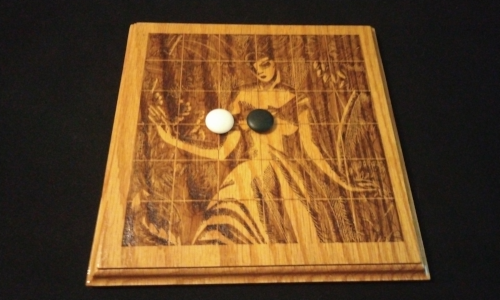
Players are trying to capture area and opposing stones.
Capture:
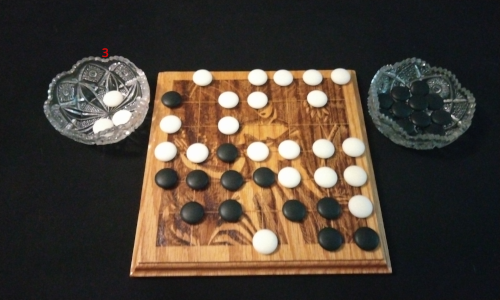
Surround an enemy stone (or group of stones) on all orthogonal sides with your move. They are captured. The capturing player takes the pieces for scoring later.
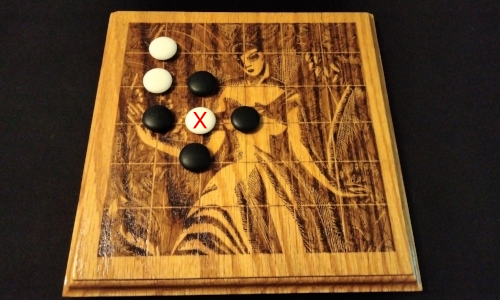
A group of stones with two empty spaces within it separately (these are called Liberties) cannot be captured.
Examples C and D
Ko: Pronounced like Cone, Ko is a rule in Go that says you cannot create the previous board position with your next move. Ko prevents back and forth loops of capture. Ko only applies to captures of single pieces.
For instance if the opponent captured one of your pieces, but you could capture their piece right back by playing in that same place of the now captured piece. You cannot place there this turn. You must place elsewhere first.
Pass: Each player may pass instead of playing a stone. If you are out of your own stones, you must pass. If both players pass consecutively the game ends and scoring begins.
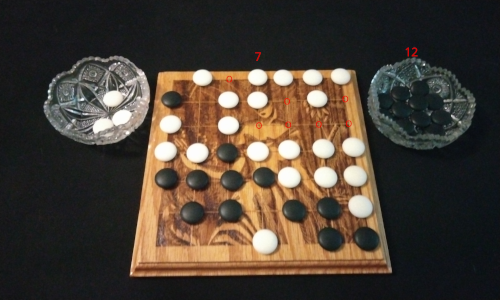
Scoring: Points are awarded for each uncontested empty point surrounded as well as for each captured piece. Whoever has the most points wins! In case of ties, winner is the one with most captures. If still tied then you are both equally matched. Play again!
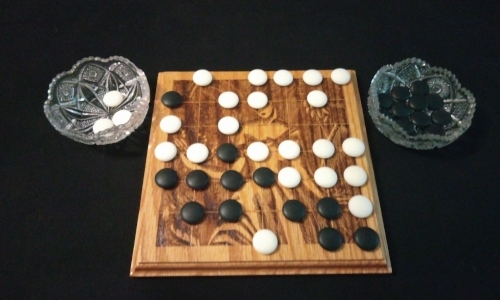
Here we have a finished game of 7x7 grid using 24 pieces.